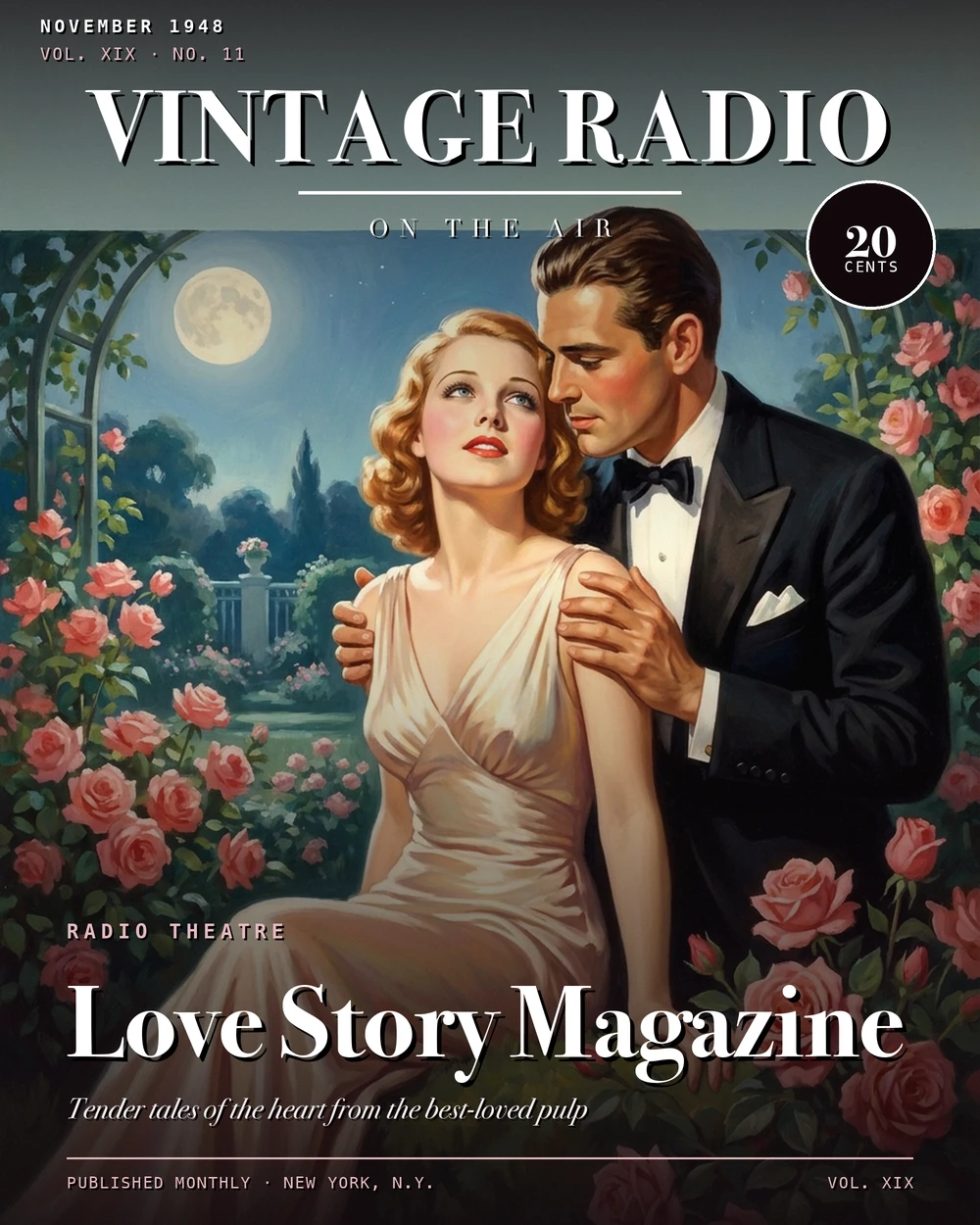
Love Story Magazine
Where It Came From
Love Story Magazine the radio show had a powerful parent. Street & Smith's Love Story Magazine pulp was, by any measure, the most successful pulp fiction magazine ever published — circulation stood at 100,000 in 1922 and climbed to 600,000 copies per issue in the early 1930s, a record no other pulp ever broke. The magazine ran from 1921 to 1947, edited for much of that run by Daisy Bacon, who held the job from around 1928 through the final issue. Bacon later wrote Love Story Writer (1954), a how-to guide on romance fiction — a natural coda for someone who had shaped the genre for nearly two decades. With that kind of circulation and that depth of story inventory, the leap to radio was almost inevitable.
The radio series appears to have started as early as 1931. A Radio Guide listing from July 9 of that year shows the program running as a full hour — unusually long for a serial of any type. A Radio Guide advertisement from November 14, 1931 described it as "a thrilling, tender drama that will hold you in its spell." By 1936, the episodes had settled into the 15-minute format that had become standard for daily serials and soap operas across the dial. The surviving episode record places the catalogued run in 1937, with the earliest known broadcast dated March 26 and the latest September 17 of that year. Recordings attributed to a 1937–1938 run also exist, suggesting the show continued at least slightly past that September cutoff.
How the Show Actually Worked
The most unusual thing about Love Story Magazine's format was its central casting choice. Rather than following a single continuing character through every episode, the show used a stock company built around one lead actress billed simply as "The Love Story Girl." Each week she stepped into a new role — a different woman, a different situation, a different man. It was anthology storytelling wrapped inside a serial package, and it solved a real problem: how do you adapt a magazine full of standalone short stories for a radio audience that expects to tune in week after week?
The source material made this approach workable. Love Story Magazine published series, standalone short stories, and poetry across its run, giving the radio writers a deep well to draw from. The surviving episode titles hint at the range of settings and moods the show covered: "Gay Red Cape," "Two Diamond Bracelets," "Bitter Triumph," "Tiny Pink Elephant," "Love at Midnight," "Devil Wind," "Forgotten Girl," "Weekend Party," "The June House Party," "A Prince Arrives," "Army Kisses," "A Toast to Cinderella." Some suggest high society; others feel like they belong on a farm or a college campus. The show deliberately ranged across settings — high society, the circus, a newspaper office, a farm, college — which kept the series fresh and reflected the realistic variety of places where people might actually meet and fall for each other.
The Sound of It
The production leaned into romance at every level, including the music. Transitional cues used string instruments with an ethereal quality — the kind of sound that signals settling in for something intimate. Frank Knight served as the announcer, the steady voice that framed each new story. The storytelling itself was built on intimate dialogue and relatable personal scenarios, with episodes structured to include both cliffhangers and what the format promised most: heartfelt moments between characters navigating love, conflict, and the particular kind of resilience that comes with getting your heart broken and going on anyway.
Characters in these episodes faced personal tragedies and relationship struggles, which was standard for the soap opera form. But the anthology structure gave the show a slightly different texture than a continuous serial like Ma Perkins or Backstage Wife. There was no long-running plotline to follow, no years of backstory to absorb. Each episode was a self-contained dramatic unit, which likely made it easier to pick up mid-run — and easier to drop without feeling lost.
What Survives
The catalogued run accounts for 26 known episodes between March and September 1937. Seventeen recordings survive in known collections, with a combined running time of roughly three hours and fifty-five minutes. That's a partial picture of what was almost certainly a longer run — the show's history stretches back to at least 1931, and the trail of evidence suggests it kept going into 1938. What those surviving episodes represent is a cross-section of a show that spent years finding its format and at least one full season working it in the tight 15-minute daily-serial form.
The show's connection to the pulp magazine that spawned it gives these episodes an extra layer of interest. Each dramatization was drawn directly from stories that had already found a mass audience in print — stories shaped by Daisy Bacon and her editorial instincts about what romance fiction readers actually wanted. Hearing them as radio drama is, in a sense, hearing the same stories translated for a different kind of intimacy: not a reader alone with a page, but a listener alone with a voice.